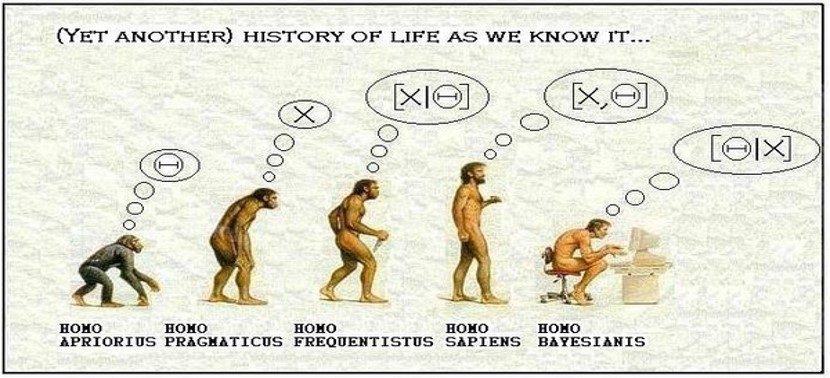
This is a classroom activity that compares the objective world with mental models, and shows stages of cognitive evolution from an econometrics point of view.
Flow: first complete a single-choice item in the smart classroom, then match the five school labels, and finally enter the counts into the chart.
Quiz
When you face something uncertain (school, going abroad, a business), which approach is closest to yours? (single choice)
A
I watch what is happening and revise my story about the rules behind it—tracking and updating both at once.
B
I already have the rules in mind; what is happening in front of me does not need looking at, and it will not change my view.
C
Never mind the rules behind it; whichever method works today, right in front of me, is the one I use.
D
I first accept a set of rules, then check how often the things in front of me would occur under those rules—whether they repeat.
E
I start with a view, then use newly seen events to revise how sure I am.
Enter the counts from the smart-classroom poll. Bars follow the order of the five cognitive stages.
Cognitive-model feedback · Total 62
Reality check
1 Prior (illiterate villager): Gut and lore—no data needed.
2 Pragmatic (wage earner): Grab the tool that works today.
3 Frequentist (white-collar): Truth is what repeats forever.
4 Modern (Musk): Build a working model, design tests, then keep repairing, iterating, growing.
5 Bayesian (Einstein): Theory first—then let evidence rewrite belief.
Background
The five “humans” in the cartoon correspond to five probability objects: \(\Theta\) is the rule/parameter, \(X\) is the observation/data.12
1 Prior\(P(\Theta)\): Talk only about the rule; even when data arrive, do not change your mind.
2 Pragmatic\(P(X)\): Care only about the facts in front of you, and whether they work today.
3 Frequentist\(P(X\mid\Theta)\): Assume a rule, then ask how common the data would be under it.3
4 Modern\(P(X,\Theta)\): Put facts and rules on the same map; model, check, and revise together.
5 Bayesian\(P(\Theta\mid X)\): Start with a belief about the rule, then rewrite it with data; that is \(P(\Theta\mid X)\propto P(X\mid\Theta)\,P(\Theta)\).4
Frequentist probability asks how often the same procedure would be right under repetition; Bayesian probability asks how sure I now am about an unknown rule.5 In practice people rarely stick to one mode: maximizing a likelihood, checking the model, and updating beliefs are often mixed together.6
Back Cross Validated. (2011, October 22). What are the modeling approaches in this cartoon? https://stats.stackexchange.com/q/17417. Image attributed to Michael West, Duke University.
Back Neyman, J. (1937). Outline of a theory of statistical estimation based on the classical theory of probability. Philosophical Transactions of the Royal Society of London. Series A, 236(767), 333–380. https://doi.org/10.1098/rsta.1937.0005
Back Bayes, T. (1763). An essay towards solving a problem in the doctrine of chances. Philosophical Transactions of the Royal Society of London, 53, 370–418. https://doi.org/10.1098/rstl.1763.0053
Back Gelman, A., & Shalizi, C. R. (2013). Philosophy and the practice of Bayesian statistics. British Journal of Mathematical and Statistical Psychology, 66(1), 8–38. https://doi.org/10.1111/j.2044-8317.2011.02037.x